Long stock doesn't share evenly.
A long length resting on four arms behaves like a continuous beam. The two inner arms carry 1.1/3 of the level: 367 kg each, not 250. A rating that is honest has to be stated per arm.
Your rack says 1,000 kg per level. What does each arm actually carry, and will the rack stay put in a cyclone? Structural checks and strengthening designs for cantilever racks and yard steel structures, starting from the steel you already have. Calculated to AS 4100, AS/NZS 1170.2 and AS 5216, and checked by independent FEA.
From a recent check of a steel cantilever rack in a Pilbara yard, wind region D: four frames, five levels, 1,000 kg per level. The easy answer was 250 kg per arm. The engineering answer was different.
A long length resting on four arms behaves like a continuous beam. The two inner arms carry 1.1/3 of the level: 367 kg each, not 250. A rating that is honest has to be stated per arm.
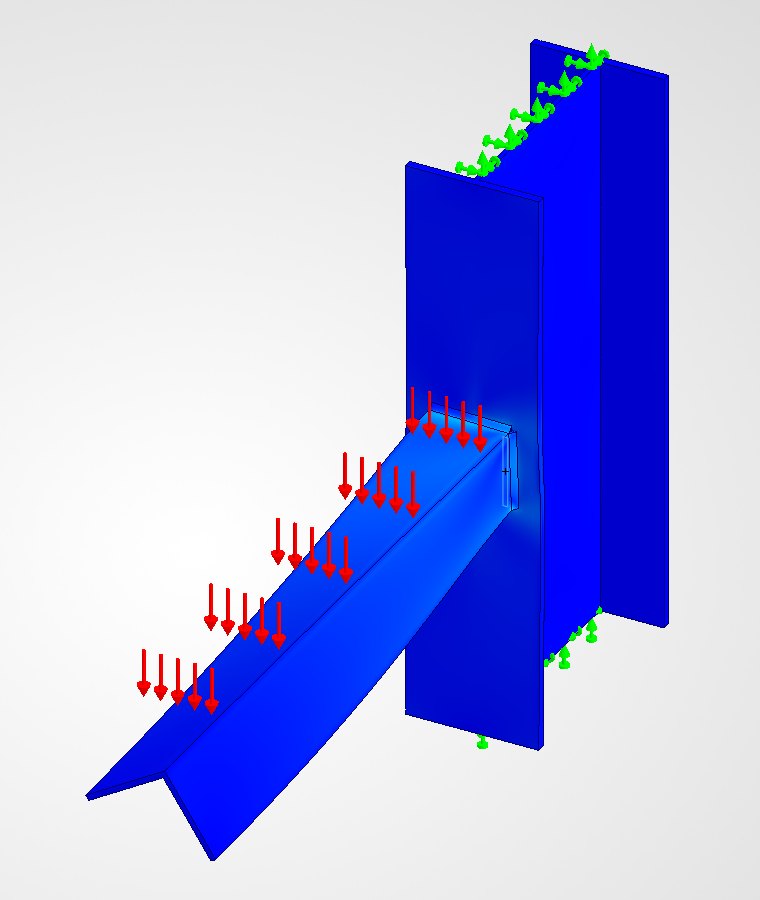
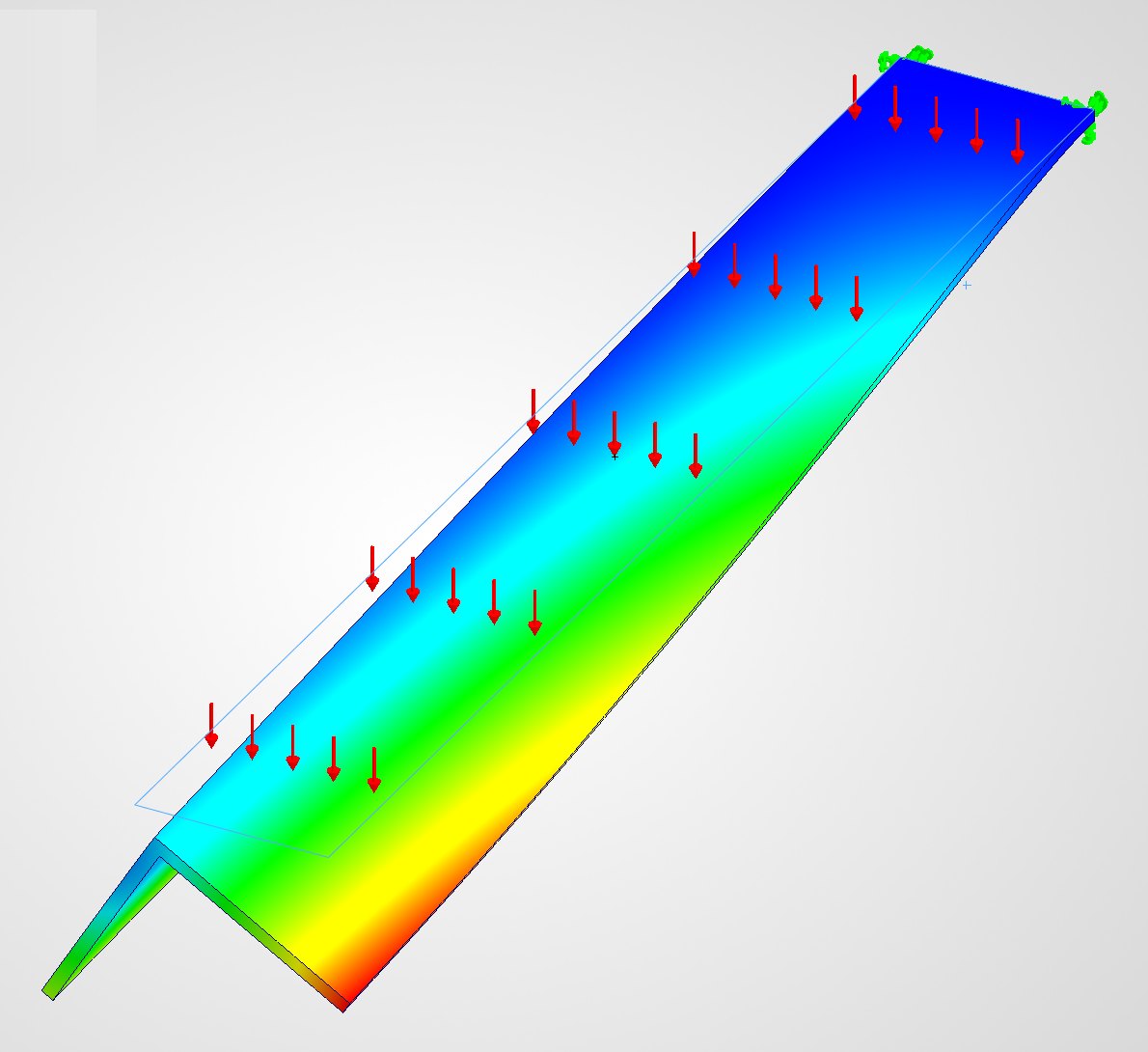
An equal angle's shear centre sits at its heel, so a bundle resting on the leg loads it off centre. The bare angle arm that passed in bending alone failed once torsion was included, and failed at 250 kg with the bundle at the toe.
In cyclonic regions C and D, wind on a loaded rack's stored material can add more force than wind on the rack's own members. That decides the anchors, the footing, and whether the rack has to be emptied on a cyclone watch.
Most yard racks are built from steel that was already on hand. The first question is what that steel can do, and the cheapest set of changes that closes the gap. On the Pilbara rack, the recommended scheme kept the client's uprights and bases and used angle already in the yard.
A second angle welded toe to toe turns an open angle into a closed section in the same 100 x 100 envelope. Torsion stops being the problem.
Arm to upright welds sized for the real moment and twist, checked by the elastic weld group and by a model of the welds themselves.
Stiffener pairs in the base beam under the upright flanges, so the web carries the upright's force in a cyclone.
Anchors at the ends of the base, where the lever against tipping is longest, designed to AS 5216 on the FEA envelope, not the optimistic hand value.
Thickened pads cast with the yard slab and anchor setout issued before the concrete goes down, not cored in afterwards.
Emptying the rack on a cyclone watch can halve the footing. The calculation shows both options so the owner can choose.
The calculation and the finite element models are built independently from one design basis. Where they agree, the answer is confirmed. Where they don't, the design takes the larger and says why.
Written for the owner who signs the purchase order, the fabricator who builds the fix and the concreter who pours the pad.
The rack, the arm connections, the base and a tape measure on the members. Tell me what you want to store and where the yard is.
A short call, then a fixed fee for the check. If it's clearly fine or clearly not, you'll hear that first.
Member sizes, weld sizes, base and slab details. Measured, not guessed.
Hand calculation, independent FEA, and the strengthening scheme if the rack falls short.
Ratings, calcs, sketches and setout, plus answers for the fabricator while the fix is built.
Why cantilever racks need engineering. AS 4084 covers steel storage racking but excludes cantilever racking, so a cantilever rack has to be rated from first principles: the arms, their connection to the upright, the upright, the base, the anchors and the footing. In the Pilbara and the north-west, cyclonic wind usually decides the last three.
Clear on scope: I do the engineering checks and design as a mechanical engineer (MIEAust NER). Where a structure needs certification or sign-off by a registered practitioner, that is coordinated with one, and I tell you upfront when it applies. The fabricator builds the strengthening and the concreter pours the footing.
Also for other yard steel: pipe and cable racks, storage frames and shelters, platforms and access structures built in-house. NDA on request.
Send a few photos and the load you want to store. A free first look, then a fixed-fee check.
Send a photo of your rack