The fan is rated at free air.
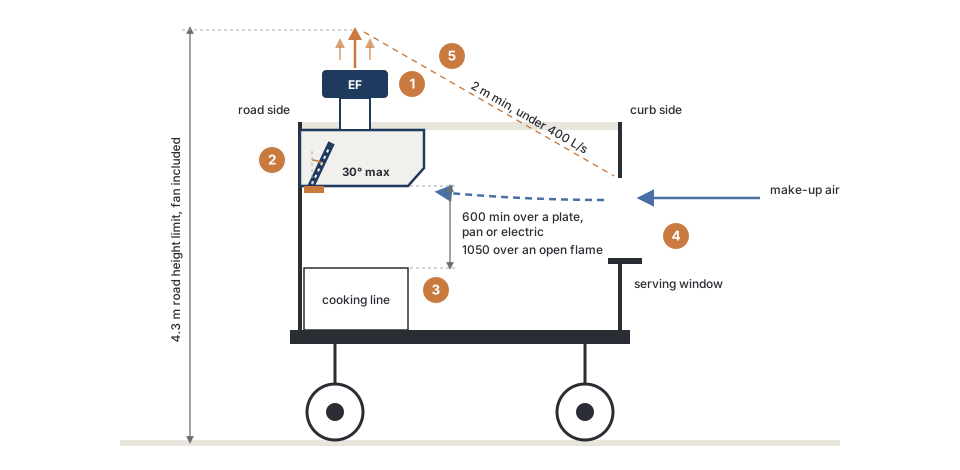
Small axial fans are rated with nothing in front of them. Put filters in front and the real airflow falls, usually below what the hood needs. A fan mounted inside the hood also puts its motor in the grease stream.
The council has asked for written certification that your trailer’s exhaust complies with AS 1668 Part 2. I measure the trailer, check it clause by clause, tell you plainly whether the existing system can be certified, and design the smallest set of changes that makes it comply. After the work is done I commission it, measure the airflow and put it in writing.
A trailer’s exhaust usually looks right. Whether it is right comes down to four things the check measures, each with a clause behind it.
Small axial fans are rated with nothing in front of them. Put filters in front and the real airflow falls, usually below what the hood needs. A fan mounted inside the hood also puts its motor in the grease stream.
AS 1668.2 wants filter faces vertical or within 30° of vertical, so grease drains instead of dripping, and every filter working inside its maker’s flow and temperature limits. Unrated aluminium mesh has no limits to check, and some council guidelines ask for baffle filters listed to UL 1046.
The lowest edge of the filters has to be 1050 mm above an open flame, or 600 mm above an electric appliance or a fixed plate or pan over gas. Inside a trailer about 2 m high, 1050 mm rarely fits. A flat plate or an electric hob usually does.
A low sidewall hood may drain to a removable container, but it has to have one, with a channel feeding it. Some council guidelines also ask for a light that shows the fan is running.
A cross section through a typical food trailer, and the five things that have to be right for the exhaust to be certified.
AS 1668.2-2002, the edition several WA council guidelines still name, gives two ways to set the exhaust airflow. The prescriptive route multiplies the hood length by a factor for the hardest-working appliance under it. The other route, intended for several appliances sharing one hood, rates each appliance on its own cooking surface and its own process type.
On a recent trailer the prescriptive route asked for about four times the air of the cooking-surface route. Four times the air means a bigger fan on the roof, more air pulled through the serving window, and a discharge that has to sit further from every opening. The cooking-surface route gave a fan that fits and an outlet that keeps its distance.
That is the decision most worth getting right. Under 400 L/s, the Standard asks for 2 m between the outlet and any intake, natural ventilation device or opening, and that band is what makes a compliant trailer workable.
Council hood guidelines are written for fixed kitchens. Several add a hood lower edge 2 m above the floor, a discharge 3 m above a flat roof, and 6 m from boundaries and air intakes. A trailer about 2 m high inside, under a 4.3 m road height limit, cannot meet those literally.
The answer is not to ignore them. It is to list each one, show what AS 1668.2 itself allows, and ask the council to accept it in writing before anything is fabricated. Fabricating first and asking afterwards is how a trailer gets built twice.
The council’s letter, and photos of the hood from below, the fan, the filters, the cooking line and the windows.
A short call, then a fixed fee for the visit and the report. If the trailer clearly cannot work as it is, you hear that first.
Everything measured and photographed: the hood, the filters and their angle, the fan, the clearances, the windows and the gas.
The assessment, the proposed fix and the acceptance requests, written for the environmental health officer to read.
Your fabricator, gasfitter and electrician build to the reviewed drawing. Questions answered while they do.
Airflow measured, capture checked with smoke, fan speed locked, certification in writing.
I assess, design and certify the kitchen exhaust to AS 1668.2 as a mechanical engineer (MIEAust NER). Gas work is installed and certified by a licensed gasfitter, and electrical work by a licensed electrician. The council decides whether to accept the design and the certificate, which is why the acceptance requests go to them before anything is built.
If the existing system can be certified with small changes, you hear that. If it cannot be certified as it stands, you hear that first, before you spend money on parts.
Typical clients: food trailer and food van owners with a letter from the council, people buying or selling a used trailer who want to know where it stands, and fabricators building new ones. For fixed commercial kitchens, see kitchen exhaust and ventilation design.
A site visit to measure the trailer and its exhaust, a clause by clause check against the edition of AS 1668.2 the council names, and the smallest set of changes that makes it comply. Where the council's own hood guideline cannot be met on a trailer, its written acceptance is requested before anything is built. After the work is done, the system is commissioned with the airflow measured, and the certification is put in writing.
Only if it delivers the required airflow with the filters fitted. Small axial fans are usually rated at free air, with nothing in front of them, and deliver less once filters are installed. A fan mounted inside the hood also puts its motor in the grease stream.
AS 1668.2-2002 sets no stack height for a kitchen discharge under 1000 L/s. Some council guidelines add 3 m above a flat roof, which a trailer cannot meet under the 4.3 m road height limit. The usual answer is a vertical discharge above the roof, at least 2 m from any opening when the exhaust is under 400 L/s, and a written request for the council to accept it.
Only if the grease filters sit at least 1050 mm above them, which inside a trailer about 2 m high is rarely possible. A flat plate over gas, or an electric hob, needs 600 mm, which usually fits.
A licensed gasfitter certifies the gas installation and a licensed electrician the electrical work. The exhaust certification covers the ventilation to AS 1668.2.
Send the letter and a few photos of the hood, the fan and the cooking line. Free scoping call, then a fixed fee for the visit and the report.
Send the council’s letter